
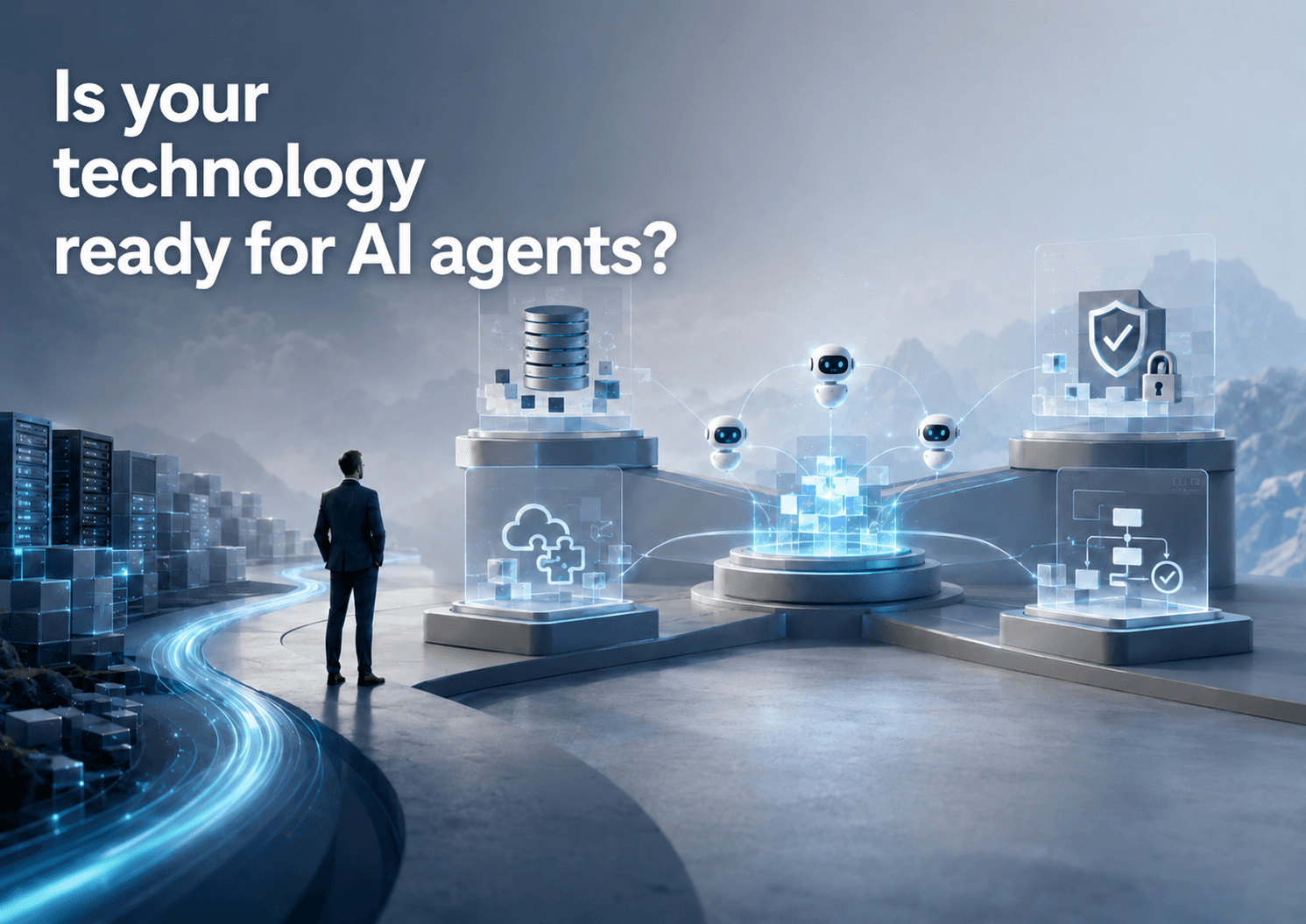
The question is arriving in every boardroom in roughly the same words: are we ready for AI agents. It is usually asked with the expectation that the answer is about the agent. It is not. The answer is about the systems underneath the agent, the same systems this series has been about, and the honest version of the answer is uncomfortable, because an agent does not improve any of them. It inherits all of them, and it removes the person who was quietly covering for the parts that did not work.
This is the capstone of a six-part series on technology modernization for executives. The earlier parts covered whether to modernize, what it costs, how to decide, who to buy from, and why programs fail. This part is where they converge, because AI agent readiness is not a new topic. It is every problem in the previous five, with the human who used to absorb those problems taken out of the loop.
Why the agent makes everything you postponed expensive
Across this series, the recurring theme has been hidden cost absorbed by people. The manual reconciliation that exists because the system cannot do it. The report nobody trusts, so someone checks the real number. The integration that does not exist, so a person carries data across the gap by hand. For decades, those gaps were survivable because a human stood in each one and quietly made it work.
An agent does not stand in the gap. It acts on the data it is given. If the data is wrong, it acts wrongly, quickly, and at scale, with no human pausing to think "that number looks off." Everything you deferred because a person was compensating for it becomes a direct, customer-visible or decision-visible failure the moment the agent replaces that person. This is why AI readiness is not an AI question. It is a data, integration, and governance question, and those were already your modernization questions.
The four-point readiness check
You can run this without technical depth. It is the same discipline as the earlier parts, applied to one question.
1. Is there a single source of truth for the data the agent would act on? If the same fact lives in three systems with three values, a human picks the right one from context. An agent cannot. Until there is one authoritative source, the agent has nothing reliable to stand on, and readiness is not a tooling problem, it is a prerequisite.
2. Do you actually trust that data, or do you quietly check it? If your own leaders disbelieve a report and verify it informally, that informal verification is a person doing the agent's quality control. Remove the person and the agent ships the error. Trusted data is not a nicety here. It is the floor.
3. Does the integration the agent needs already exist, or are people the integration? Agents act across systems. If today a person is the bridge between two systems, that bridge does not exist in any form an agent can use. Naming where people are silently functioning as integration tells you exactly where an agent will fail first.
4. Does anyone own this, with authority and budget? Agent readiness is a governance question more than a technology one. If data quality and integration are everyone's responsibility and therefore no one's, an agent will expose that the same way it exposes everything else, faster and more publicly than a human ever did.
Weak answers do not mean do not pursue agents. They mean the readiness work is the modernization work, sequenced before the pilot, not discovered during it. A pilot run on top of unaddressed gaps does not test the agent. It tests how loudly your existing problems can fail.
A worked example
The clearest place to see this concretely is retail, where agent-led buying is furthest along and the data underneath it is most exposed. The mechanism is not retail-specific. The catalog is just a vivid version of the single-source-of-truth problem every business has, and it connects directly to why AI agents need reliable data pipelines before they can be trusted in production.
The through-line of the whole series
Six parts, one argument. Modernization is not about technology being old. It is about cost you cannot see, decisions you cannot defend, and gaps that people are silently absorbing. For decades you could defer all of it, because a person was always in the loop paying that cost on your behalf. The agent is the event that ends the deferral, because it removes the person and acts on what is actually there. The companies that handle 2026 well will not be the ones with the best agent. The agent is becoming a commodity. They will be the ones whose data, integration, and governance were already honest enough to hand to one without flinching, which is the unglamorous modernization work this entire series has been describing.
If you want a direct, vendor-independent read on where your business actually stands against that bar, that is the conversation I have with executives. It is short, and it usually starts with the question of whether you trust your own data.
This concludes the six-part series. Return to the technology modernization series overview for the rest of the parts.
Frequently asked questions
Is our company ready for AI agents?
Readiness is not about the agent. It depends on whether you have a single source of truth, data you actually trust, integration that exists without people bridging it manually, and clear ownership. Weak answers mean the readiness work must precede any pilot.
What do AI agents need from a business's technology?
Reliable, single-source data, real integration between systems, and governance that owns data quality. Agents act on what they are given without the human judgment that used to catch errors, so gaps that were survivable become direct failures.
Why do AI pilots fail to deliver value?
Most fail because they run on top of unaddressed data, integration, and governance gaps. The pilot then measures how loudly existing problems fail rather than whether the agent works. The remediation is ordinary modernization work, sequenced before the pilot.
Is AI readiness a technology problem or a governance problem?
Primarily governance. The technical gaps are usually known. What is missing is single ownership with authority and budget to make data trustworthy and integration real, which an agent will expose faster and more publicly than a human ever did.