
IBM closed its $11 billion acquisition of Confluent on March 17. The same week, NVIDIA launched its Agent Toolkit at GTC with 17 enterprise partners. These two moves tell the same story — and most enterprises are only paying attention to the wrong half.
The Agent Hype Is Drowning Out the Real Constraint
The numbers look impressive. Sixty-seven percent of Fortune 500 companies now have at least one AI agent in production, up from 34 percent a year ago. NVIDIA just handed Adobe, SAP, Salesforce, ServiceNow, and a dozen other major platforms an open-source toolkit to build and run autonomous agents.
But here is what the adoption stats do not capture: how many of those agents are actually operating on live, governed, enterprise-quality data? The answer, for most organizations, is almost none.
The industry conversation is focused on agent capabilities — reasoning, tool use, multi-step planning. Model providers are competing on benchmarks. Enterprises are running pilots. And the vast majority of those pilots are pulling from batch-processed data that is hours or days old.
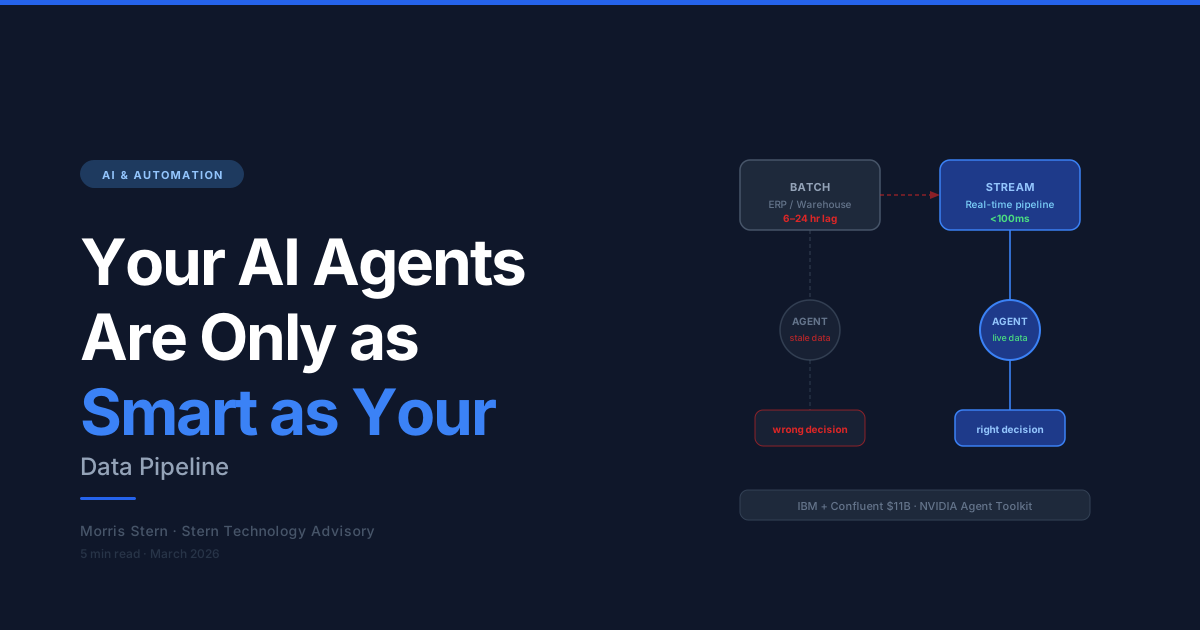
An agent making a procurement decision based on yesterday’s inventory data is not intelligent. It is automated guesswork.
Why IBM Spent $11 Billion on a Data Streaming Company
IBM did not buy Confluent because data streaming is interesting. They bought it because they recognized that AI agents without real-time data are a liability, not an asset.
Confluent’s platform powers real-time data operations for more than 6,500 enterprises, including 40 percent of the Fortune 500. Combined with IBM’s earlier acquisitions — HashiCorp for cloud automation and DataStax for vector storage — this creates an end-to-end infrastructure stack purpose-built for the agentic era: data moves in real time, gets stored in formats agents can reason over, and runs on infrastructure that scales.
The strategic signal is clear. The companies that will capture the most value from AI agents are not the ones with the best models. They are the ones with data architectures that can feed agents continuously, with lineage, governance, and quality controls built in.
What This Means for Enterprise Architecture
Most enterprise data architectures were built for reporting, not for real-time agent consumption. That gap is about to become expensive.
The batch problem. ERP systems, data warehouses, and analytics platforms process data in cycles — nightly, hourly, at best near-real-time. Agents that need to act on current state cannot wait for the next batch run. An agent managing supply chain exceptions needs live inventory, live order status, and live logistics data. Anything less produces decisions that are confidently wrong.
The governance problem. Even organizations with strong data governance programs built those programs for human consumers. Agent-ready governance requires different controls: data lineage that agents can query programmatically, access policies enforced at the API layer, PII detection applied automatically per data stream. ServiceNow’s March 2026 AI Gateway release — with its MCP server integration and per-server PII detection toggles — shows where the industry is heading.
The integration problem. Agents do not operate in a single system. They pull from CRM, ERP, supply chain, customer service, and external data sources simultaneously. If those systems are not streaming data into a unified, governed layer, the agent is assembling a picture from mismatched puzzle pieces.
The Retail Angle
Retailers face this problem at a sharper scale. Agentic commerce — where AI agents browse, compare, and purchase on behalf of consumers — is already in motion. Etsy, Target, and Walmart are partnering with Google Gemini and Microsoft Copilot to surface products through AI-driven shopping experiences.
But here is the risk that most retail technology leaders are underestimating: if your product data, pricing, and inventory feeds are not real-time and machine-readable, the agent will not surface your products. It will surface your competitor’s.
Deloitte’s 2026 Retail Industry Outlook found that 81 percent of retail executives expect generative AI to weaken brand loyalty by 2027. The retailers who will hold their position are the ones whose data infrastructure can serve agents as effectively as it serves web browsers. That means live inventory, structured product data, and pricing APIs that respond in milliseconds — not bulk feeds updated twice a day.
What Leaders Should Do Now
Stop evaluating AI agents as a software procurement decision. Start evaluating them as an architecture decision.
Audit your data freshness. For every system an AI agent would need to touch, measure the actual latency between a real-world event and when that data is available for consumption. If the gap is measured in hours, your agents will make decisions on stale information.
Build the streaming layer before the agent layer. The organizations getting the most from AI agents invested in event-driven architectures first. Data streaming is not a nice-to-have — it is the prerequisite.
Treat agent governance as data governance. Every data source an agent consumes needs lineage, access controls, and quality monitoring. This is not a new program — it is an extension of your existing data governance, applied to a new class of consumer.
Do not wait for the platform vendors to solve this for you. NVIDIA, Microsoft, ServiceNow, and Salesforce are all building agent platforms. None of them will fix your internal data plumbing. That is your problem, and the longer you wait, the wider the gap grows between your agent ambitions and your data reality.
The enterprises that will lead in the agentic era are not the ones deploying the most agents. They are the ones whose data architectures can keep those agents honest. IBM just bet $11 billion on that thesis. The question is whether your organization’s architecture supports the same bet — or is still waiting for the next batch run.