
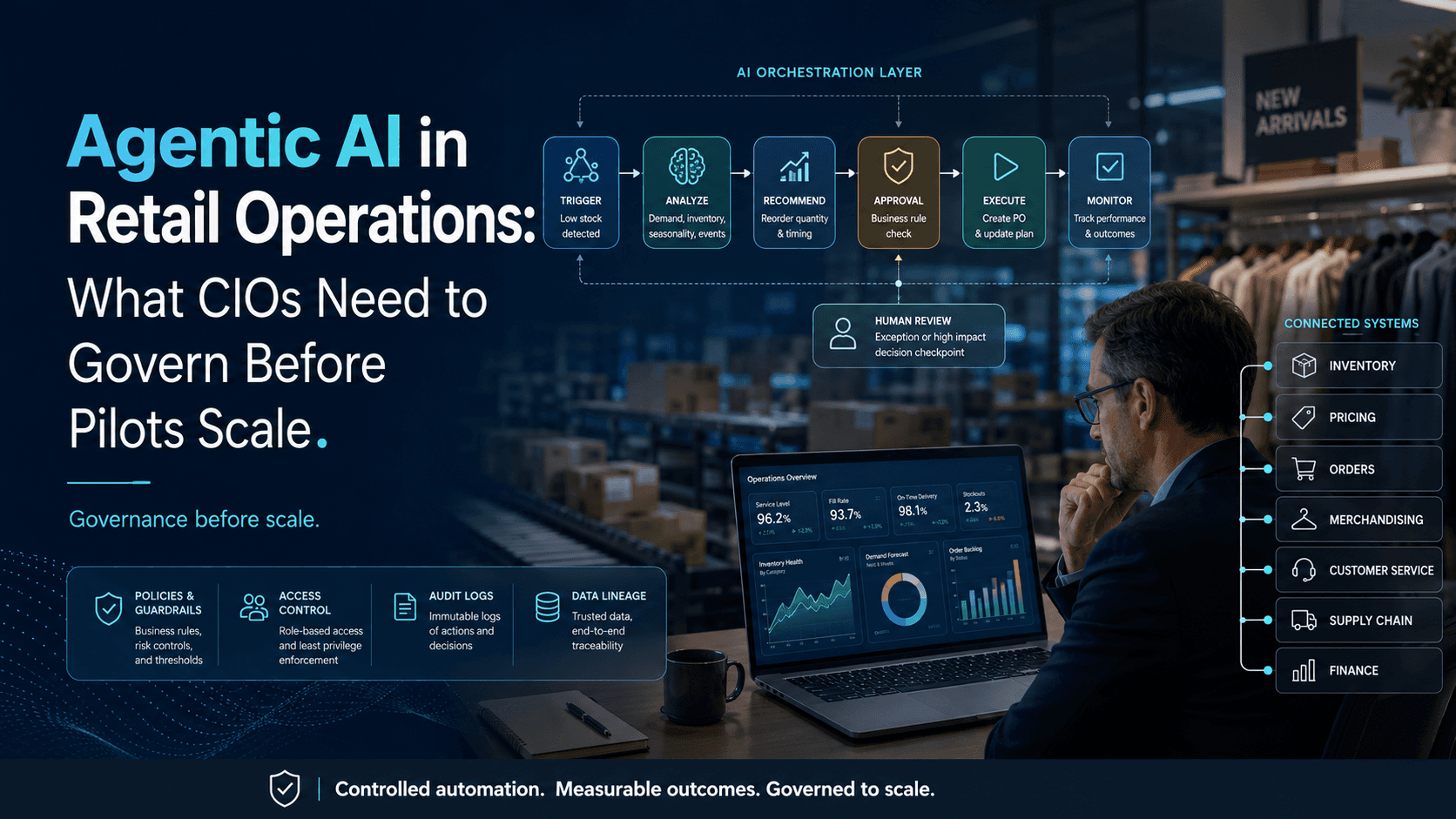
Agentic AI in retail operations is software that can interpret a goal, plan the steps, call tools, and take governed action across workflows such as inventory, pricing, service, merchandising, replenishment, and store support. It is different from a chatbot because it does not only answer. It can act.
That difference is why retail CIOs should treat agentic AI as an operating model change, not a feature launch. A customer service agent that drafts a reply is useful. A system that can investigate an order, issue a concession, update the customer, and notify store operations is something else. The governance surface is no longer the model. It is the process the model can touch.
Retail is especially exposed because the systems are tightly coupled and operationally unforgiving. Product data, inventory, pricing, orders, loyalty, payments, store labor, and vendor feeds all collide inside daily execution. When a human works around those gaps, the business absorbs friction. When an agentic system works around those gaps, the business can create errors at machine speed.
AI agents vs. agentic systems in retail
An AI agent usually performs a bounded task. It summarizes tickets, drafts product copy, classifies support requests, creates a forecast note, or queries a knowledge base. The task may be useful, but the blast radius is limited because the agent is not coordinating an end-to-end operating workflow.
An agentic system coordinates multiple agents, tools, permissions, data sources, and decision rules. In retail, that might mean a system detects a product content gap, pulls supplier data, enriches attributes, checks image availability, sends a human approval request, updates the PIM, and syndicates the change to ecommerce and marketplaces. That is no longer a writing assistant. It is a workflow participant.
The executive question changes with it. The question is not whether the model is good enough. The question is whether the workflow is governed well enough for software to act inside it.
Where agentic AI can create value first
The safest early use cases have four traits: the action is frequent, the data exists, the downside is bounded, and a human can review exceptions. Retailers should start where the work is repetitive but judgment still matters.
- Store support triage: classify issues, gather context from POS and ticketing systems, recommend resolution paths, and escalate only the cases that need a person.
- Product content enrichment: identify missing attributes, propose normalized values, check channel readiness, and route exceptions to merchandising or vendor teams.
- Order exception handling: detect stuck orders, collect status across OMS, ERP, carrier, and store systems, then prepare the next best action for approval.
- Promotion readiness: check whether price, signage, inventory, ecommerce content, and store execution data agree before the promotional window opens.
These are not glamorous use cases, which is part of why they are useful. They expose whether the data, integrations, and ownership model are ready before the retailer lets agentic systems affect pricing, inventory movement, customer refunds, or labor decisions directly.
The retail readiness test
Before scaling agentic AI, ask five questions. If the answers are weak, the pilot may still produce a demo, but it will not produce a dependable operating capability.
1. Which system owns the truth? For product, inventory, price, customer, and order data, the source of truth must be explicit. If teams still debate which report is real, agents will inherit the ambiguity.
2. What can the system do without approval? Every workflow needs action thresholds. Drafting copy may be autonomous. Publishing copy may require approval. Issuing a small courtesy credit is different from refunding a high-value furniture order.
3. How is agent access managed? Agents need identities, roles, least-privilege permissions, and revocation paths. Shared credentials and inherited admin access turn a pilot into a security problem.
4. Can every action be explained and reversed? Tool calls, inputs, outputs, approvals, and overrides need logs. Retail operations will accept automation when failures can be traced and unwound.
5. Who owns the business outcome? Agentic AI cannot be owned by IT alone. The accountable owner for store support, merchandising, ecommerce, supply chain, or customer service needs to own the operating policy the agent follows.
Governance controls CIOs need before scale
Agentic AI governance should be operational, not ceremonial. A policy document is not enough. The controls need to exist in the workflow: identity, access, approvals, logs, rollback, escalation, and monitoring.
A practical control model has three layers. The first is access control: what data and tools each agent can touch. The second is decision control: what the agent can decide alone, what requires approval, and what is blocked entirely. The third is outcome control: what metrics, exception rates, and business impacts determine whether the workflow expands, pauses, or gets redesigned.
This is where retail technology debt shows up. If product data governance is weak, agents will publish inconsistent content faster. If POS and ecommerce pricing disagree, agents will route around a policy conflict that leadership never resolved. If inventory accuracy is poor, agents will not fix it. They will expose it in more places.
A 90-day path that does not turn into theater
The useful first 90 days are not about deploying as many agents as possible. They are about proving one governed workflow can run with measurable value and bounded risk.
Days 1-30 should define the workflow, business owner, source systems, data ownership, action thresholds, and failure modes. Days 31-60 should build the pilot with identity, tool permissions, logs, approval paths, and exception reporting. Days 61-90 should run the pilot in representative operating conditions and decide whether to scale, revise, or stop based on evidence.
That cadence is slower than a demo and much faster than an enterprise transformation program. It respects the reality of retail operations: the goal is not to prove that an agent can act. The goal is to prove that the business can govern the action.
The bottom line
Retailers that treat agentic AI as a productivity feature will get scattered pilots and impressive demos. Retailers that treat it as a governed operating capability will be more selective at first and faster later, because the controls will already exist when the use cases become more sensitive.
The winner is not the retailer with the most agents. It is the retailer whose systems architecture, data ownership, and governance model are strong enough to let software act without turning every exception into an incident.
If you are trying to decide whether your retail stack is ready for agentic workflows, start with the technology modernization readiness assessment or review the AI governance guide. The AI work gets easier when the operating foundation stops being guesswork.
Frequently asked questions
What is agentic AI in retail operations?
Agentic AI in retail operations is software that can interpret goals, plan steps, call tools, and take governed action across retail workflows such as inventory, pricing, service, merchandising, replenishment, and store support. The difference from basic AI agents is the system-level ability to coordinate actions across processes, not just answer a question.
What is the difference between AI agents and agentic systems in retail?
An AI agent usually performs a bounded task, such as summarizing a ticket or drafting a response. An agentic system coordinates multiple agents, data sources, tools, permissions, and decision rules across an operating workflow. In retail, that means the governance surface expands from one prompt to the full process the system can affect.
Where should retailers use agentic AI first?
Start with workflows where the decision is frequent, the data is available, the downside is bounded, and the action can be reviewed. Good early candidates include store support triage, product content enrichment, exception handling, and internal planning workflows. Avoid autonomous pricing, inventory moves, or customer-impacting actions until governance is mature.
What governance controls do retail CIOs need before scaling agentic AI?
Retail CIOs need identity for every agent, least-privilege access, approval thresholds, tool-use logs, data lineage, rollback paths, escalation rules, and business ownership for each workflow. Without these controls, agentic AI turns existing data and integration debt into operational risk.