
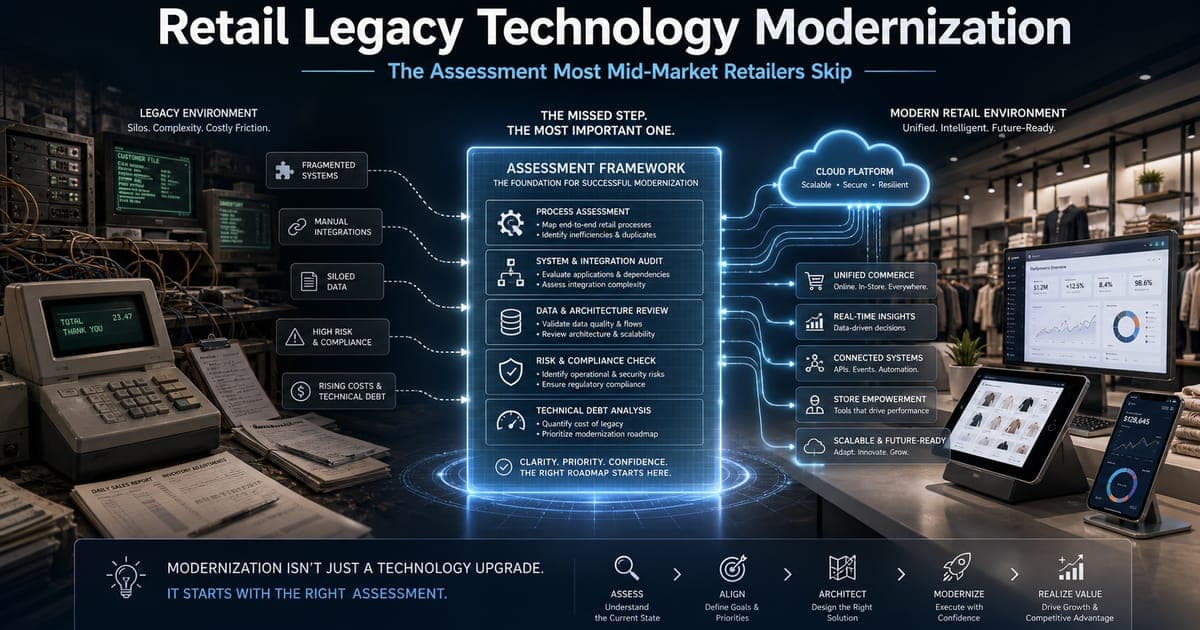
The most common reason mid-market retail modernization programs fail is that they were never assessed honestly to begin with.
The board approves a number. The vendor pitches a platform. A systems integrator scopes a timeline. Eighteen months later, the program is in red, the timeline has slipped twice, and nobody can answer the most basic question: what was the actual current state we were modernizing from?
That gap — between what the modernization program assumed about the existing environment and what was actually in production — is where most cost overruns and delivery failures live. It is exactly what a real modernization assessment exists to prevent.
I have spent the last fifteen years inside retail technology programs across Canada and the United States. I have run modernization assessments before, during, and after major transformations — including environments where the assessment was the only thing that kept a stalled program from becoming a write-off. The patterns are consistent enough that they deserve to be named clearly.
This guide explains what a retail legacy technology modernization assessment actually is, what it should produce, and how mid-market retailers — typically running 50 to 500 stores on $200M to $2B in revenue — should structure one before committing to a roadmap.
What an Assessment Is Not
Before getting to the structure, it is worth being explicit about what an assessment is not.
It is not a vendor demo. It is not a partner-led discovery workshop tied to a downstream implementation contract. It is not a generic digital maturity scorecard produced by a Big Four firm. And it is not the slide deck the systems integrator runs to confirm what they already plan to sell you.
Each of those exercises has a place. None of them produces an honest current-state assessment, because none of them are independent of the program that follows.
A real assessment is independent. It is conducted by someone who is not selling the modernization program, the platform, or the implementation services. The output is a current-state map that the retailer owns — not a deck that exists to support a contract that has already been negotiated.
What the Assessment Should Map
A defensible modernization assessment maps four dimensions of the existing environment. Most assessments cover one or two. The ones that actually reduce risk cover all four.
1. Current-state platforms and lifecycle. Every system in production. Vendor, version, support status, contract end date, last major upgrade. For mid-market retailers, this list typically runs to 30 to 80 systems once you include POS, ERP, ecommerce, PIM, OMS, payments, store systems, BI, integration middleware, and the long tail of departmental SaaS that nobody in IT actually inventoried. Half of those systems are usually past their supported version. That is not a finding. That is the starting point.
2. Integration dependencies. What talks to what. Which integrations are real-time, which are batch, which are point-to-point, which run through middleware. Where the data flows actually break. Most retailers genuinely do not have an accurate integration map. They have a diagram from three years ago that does not match production. The assessment produces the integration reality — including the integrations that are running but undocumented and the integrations that are documented but no longer running.
3. Data governance gaps. Where master data lives. Who owns the canonical definition of customer, product, order, inventory, and pricing. How those definitions drift across systems. Whether there is a real data ownership model or just a system of record per platform that nobody enforces. This is where most modernization programs go wrong — they replace a platform without resolving the data model underneath it, and the new platform inherits the old governance gaps within six months.
4. Delivery risks. The realistic capacity of the internal team to absorb a modernization program. Their existing change load. The vendor relationships that need to be unwound or restructured. The technical debt that has to be paid down before the new platform can land cleanly. Whether the operating model decisions the new platform will require have actually been made — or are still pending behind closed doors.
An assessment that maps all four dimensions produces something a board can act on. An assessment that maps only one or two produces a deck that supports a decision someone already wanted to make.
How an Assessment Reduces Risk
Assessments do not reduce risk by being thorough. They reduce risk by surfacing specific decisions that would otherwise be discovered mid-program, when they are far more expensive to address.
In practice, a defensible assessment produces five concrete outputs.
A sequenced modernization roadmap. Not a list of platforms to replace. A sequence — what gets addressed first, why, and what depends on it. Most retail modernization programs fail because the sequence is wrong. POS gets replaced before the integration layer is ready. ERP gets selected before the master data model is owned. Ecommerce gets re-platformed before anyone decides where product data will live. The sequence is the most expensive thing to get wrong, and it is exactly what the assessment should resolve before any vendor selection begins.
A 90-day plan. A clear list of what the retailer should do in the first 90 days regardless of which modernization path they choose. This usually includes data governance decisions, integration architecture cleanup, contract terminations, vendor accountability resets, and the operating model conversations that have been quietly avoided. The 90-day plan does not commit the business to a platform. It commits the business to the readiness work that any modernization program will require.
A vendor-independent platform fit view. What the actual platform options look like for this specific environment, this specific operating model, and this specific integration reality. Not a market scan. Not a magic quadrant. A short list grounded in what would actually work given the retailer's constraints.
A decision-grade tradeoff summary. Where the program is taking on risk and where it is reducing it. What can wait two years. What cannot wait two quarters. What the cost looks like if no decision is made — because doing nothing is also a decision, and the cost of inertia in mid-market retail is usually larger than the cost of the modernization itself.
A board-ready narrative. The same assessment, translated into the language of capital allocation, risk, and operating outcomes. Not technology jargon. The CEO and CFO need to understand what they are committing to, why, and what failure looks like before the program is approved.
Where Mid-Market Retailers Differ From Enterprise
The big-four assessment templates were built for Fortune 500 retailers with deep technology benches. They do not adapt cleanly to mid-market environments, and forcing them creates two specific problems.
The first is scope. A Fortune 500 retailer can afford a six-month, $2M assessment because the modernization program behind it is $80M and runs over five years. A mid-market retailer running $500M in revenue with a $15M modernization budget cannot. The assessment has to produce decision-grade output in six to ten weeks, not six months. Otherwise the assessment itself becomes the bottleneck.
The second is bench strength. Enterprise retailers have integration teams, master data teams, architecture teams, and program management offices. Mid-market retailers usually have a CIO, a VP of IT, two or three architects, and an outsourced helpdesk. The assessment has to account for that capacity reality, because any roadmap that assumes enterprise execution capability in a mid-market environment will fail in delivery.
That is the core reason the assessment matters more for mid-market. The cost of getting the modernization sequence wrong is proportionally larger. The bench to recover from it is proportionally smaller. And the executive team usually does not have the same depth of independent advisors to challenge a vendor-led narrative.
The Failure Modes Worth Knowing
A few patterns are worth flagging explicitly, because they recur often enough to be predictable.
The assessment that became a procurement document. The assessment was scoped by the systems integrator who then bid on the implementation. The current-state findings, conveniently, all pointed toward the platform the integrator partners with. This is not always corrupt. It is structurally biased. Independence matters.
The assessment that skipped integration. The platforms got mapped. The integrations did not. Six months into implementation, the integration scope tripled because nobody had actually documented what the legacy environment was doing in production. The cost overrun came from the integration layer, not the platform.
The assessment that did not produce a sequence. The output was a list of recommendations with no priority. Every department lobbied for their system to go first. The roadmap got built around political bandwidth, not architectural dependency. Two years later, the program was rebuilding itself from the data layer up because the original sequence ignored data governance.
The assessment that stopped at the technology. The platforms were assessed. The operating model was not. The retailer bought the platform that fit a future state they had not actually committed to. The implementation spent the first year arguing about process before it could configure anything.
Each of these is recoverable, but recovery is more expensive than getting the assessment right the first time.
Practical Starting Points
If you are a mid-market retail CIO, CTO, or IT director who is staring at a modernization decision in the next twelve months, the most useful thing you can do this quarter is not commission an assessment. It is define what an honest assessment would actually look like.
Three questions are worth answering before you scope one.
Who would conduct the assessment, and what is their relationship to the modernization program that follows? If the same firm assessing the environment is bidding on the implementation, the independence is compromised by construction. That does not mean the assessment is useless. It means the assessment is a procurement document, and you should treat it as such.
What does the assessment have to produce for the board? If the answer is unclear, the assessment will produce a deck that nobody can act on. Define the decision the board needs to make. Reverse-engineer the assessment scope from there.
What capacity exists internally to absorb the findings? An assessment that produces forty recommendations the team cannot execute is worse than no assessment. The output has to fit the operating reality of the team that will deliver against it.
The Closing Reframe
Modernization assessments do not reduce risk by being comprehensive. They reduce risk by being honest about the current state, the sequence, and the readiness gap — and by being independent enough to surface the things the implementation partner has every incentive to leave out.
The retailers who get the most out of modernization programs are not the ones with the biggest budgets. They are the ones who started with an assessment they could trust.
Everyone else is paying for the assessment they should have done. They are just paying for it inside the implementation, eighteen months in, when the cost is much higher and the options are much narrower.
I conduct independent modernization assessments for mid-market multi-site retailers across Canada and the United States through Stern Technology Advisory. The work is grounded in operating experience: ERP migrations, point of sale rollouts, shelf-edge pricing deployments, and ecommerce builds at chain scale.