
The most expensive misunderstanding in retail technology right now is the belief that unified commerce is something you buy.
It is not. And the retailers learning this in 2026 are learning it the hard way, eighteen months and several million dollars into programs that were sold as platform consolidation and are quietly being rebranded as integration projects.
I have spent the last fifteen years inside retail technology transformations across Canada and the United States. I have sat in the rooms where unified commerce gets pitched, where it gets approved, and where it gets explained to the board two years later when the timeline has slipped and the scope has shrunk. The pattern is consistent enough now that it deserves to be named.
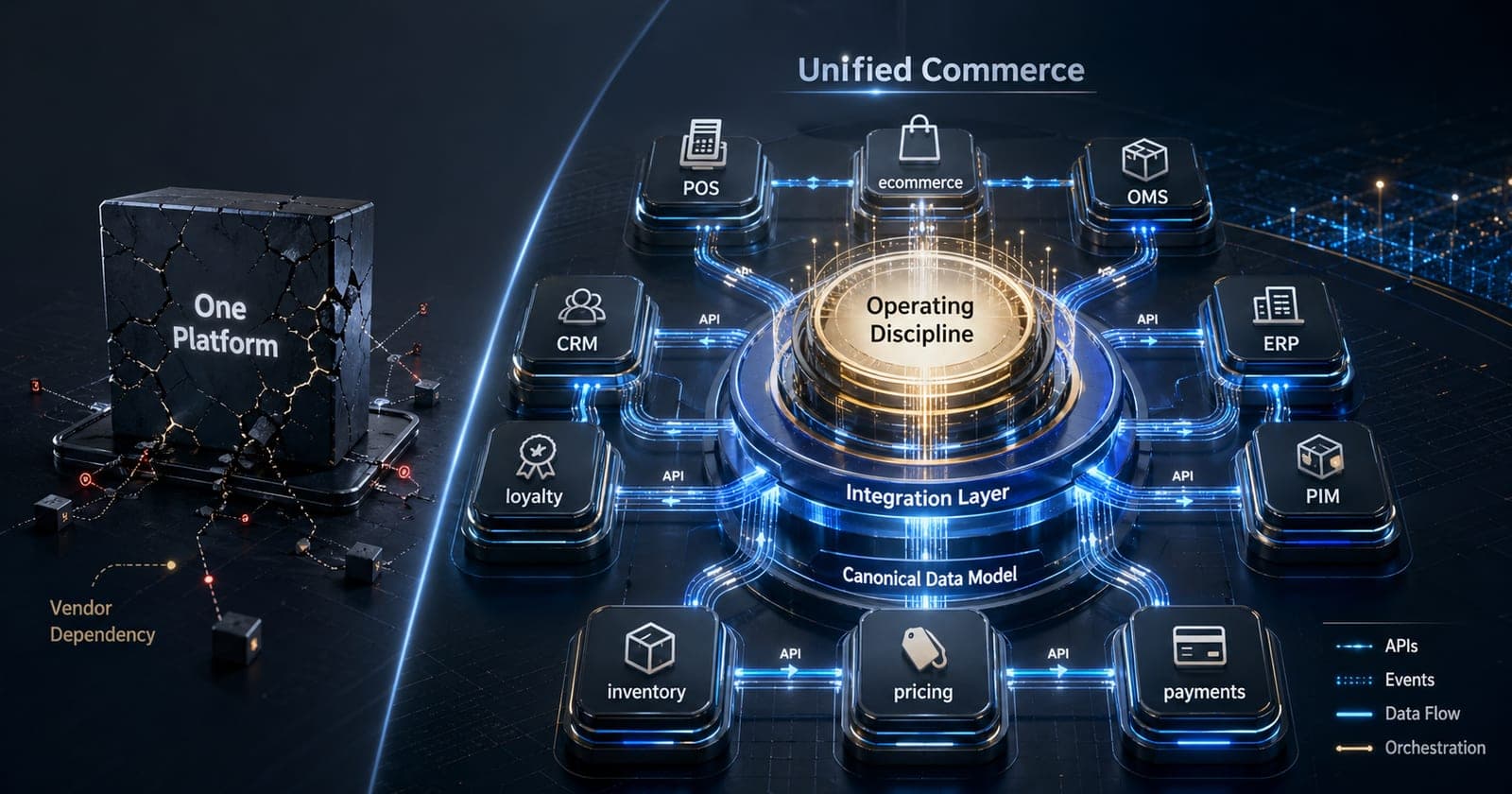
Unified commerce is an operating discipline. It is not a product, a platform, or a vendor.
The sooner senior retail technology leaders internalize that distinction, the sooner their roadmaps start reflecting reality.
The Assumption That Sells the Deal
Walk into any major retail technology conference and you will hear the same pitch in slightly different packaging. One platform for commerce. One view of the customer. One source of truth for inventory, orders, pricing, and promotions. Replace your fragmented stack. Achieve unified commerce.
The pitch is compelling because the pain is real. Most retailers genuinely are running fragmented stacks. Order management does not talk cleanly to store systems. The e-commerce platform has its own pricing logic that drifts from the POS. Inventory visibility is partial at best. Customer data lives in four systems and reconciles in none.
So when a vendor walks in and says “one platform solves all of this,” it lands. The CIO sees a way out of a problem that has been compounding for a decade. The CFO sees consolidation savings. The board sees a clean narrative.
The deal gets signed. The program gets launched. And about nine months in, the truth starts to surface.
What Actually Happens in Year Two
Nobody runs one platform. Not at scale. Not in retail.
The largest, most sophisticated retailers in North America run somewhere between eight and forty platforms in their commerce stack, depending on how you count. The ones with the best unified commerce experiences are not the ones with the fewest platforms. They are the ones with the best integration discipline.
This is the inversion that vendors do not want you to see. The retailers winning at unified commerce are not platform-consolidated. They are integration-mature.
What does that actually mean in practice?
It means they have invested in the boring infrastructure. Event-driven architecture. A clearly defined integration layer. Master data governance that is owned by a named human, not a committee. API standards that are enforced. A data model that survives vendor changes because the model is theirs, not their vendor’s.
It means they treat integration as a permanent capability, not a project. They have integration engineers on staff. They have a roadmap for the integration layer that is independent of any single vendor’s roadmap. They make architectural decisions based on what their business needs to do, not what their platform can do today.
The retailers struggling at unified commerce are doing the opposite. They are betting that one vendor’s roadmap will eventually align with their business. It almost never does. And by the time they figure that out, they have rebuilt their commerce stack around assumptions the vendor has already started to walk back.
Why the Platform Story Keeps Selling
If the platform-as-unified-commerce story is wrong, why does it keep working?
Three reasons.
The first is that integration discipline is invisible from the outside. You cannot put it on a slide. You cannot demo it to the board. It does not have a logo. A platform has a logo, a roadmap, a sales team, and a reference architecture diagram you can point at. The integration layer that actually makes unified commerce work has none of those things. It is plumbing, and plumbing does not sell.
The second is that integration discipline is harder to fund. CFOs understand platform spend. It has a vendor, a contract, and a clear line item. Integration capability spend is messier. It looks like headcount, tooling, and middleware that does not have a clear ROI story until something breaks. Most retail IT budgets are biased toward the visible work, which means the invisible work that actually delivers unified commerce gets underfunded by default.
The third is that the people selling unified commerce platforms are very good at their jobs. They have heard every objection. They have a slide for every concern. The pitch has been refined across hundreds of deals. The executive sponsor walks out of the room genuinely believing the platform will solve the problem, because the pitch is built to produce exactly that belief.
None of this is accidental. It is just how the market works. And it puts the burden on retail technology leaders to see past the pitch and make decisions based on operating reality.
What to Do Instead
If unified commerce is a discipline, what does the discipline actually look like?
A few patterns from retailers who are getting this right.
They define their own data model first. Not their vendor’s. Customer, product, order, inventory, location. The canonical definitions live with the retailer and are enforced across every platform that touches them. When a vendor changes their schema, the retailer’s canonical model does not move. This is foundational. Without it, every platform decision creates new fragmentation.
They invest in the integration layer as a first-class capability. Not as an afterthought, not as something the platform vendor will provide as part of the contract. A real integration capability with engineers, standards, monitoring, and a roadmap.
They sequence platform decisions around the data model, not the other way around. The question is not “what platform should we buy.” The question is “which platform best fits the data model and integration patterns we have decided to operate by.” That sequencing alone eliminates a significant amount of platform regret.
They accept that they will run multiple platforms forever. The goal is not to get to one. The goal is to operate the multi-platform reality with discipline. Order orchestration, inventory orchestration, customer identity, pricing logic — these are capabilities that often belong above any single platform, not inside one.
They build vendor-independence into every contract. Data portability clauses. Open API requirements. Exit terms that do not assume a decade of stability that nobody has ever delivered. The retailers who have been burned twice are very good at this. The ones who have only been burned once are still learning.
The Reframe
Here is the line worth keeping.
Unified commerce is not the platform you buy. It is the discipline you build around the platforms you already run.
The retailers who understand this are quietly pulling ahead. They are not on the conference stages talking about their platform consolidation. They are heads-down, operating their integration layer, evolving their data model, and making boring decisions that compound into a customer experience that actually feels unified.
The retailers who do not understand this are still buying platforms and waiting for the unification to arrive.
It does not arrive. It has to be built.
A Practical Question for the Week
If you are a retail CIO or CTO reading this, the most useful exercise you can run this quarter is simple. Ask your architecture team one question: who owns our canonical customer, product, order, and inventory model? Not which platform stores it. Who owns the definition.
If the answer is “the platform owns it,” you do not yet have unified commerce. You have a vendor dependency wearing the label.
If the answer is a named human inside your organization with a roadmap that is independent of any vendor’s roadmap, you are further along than most.
At [Stern Technology Advisory](/contact), I work with retail CIOs and CTOs across the US and Canada on the unglamorous work that actually delivers unified commerce: data models, integration architecture, and the operating disciplines that make multi-platform retail work. If your team is sitting inside a unified commerce program right now and the gap between the pitch and the execution is starting to show, happy to compare notes.