
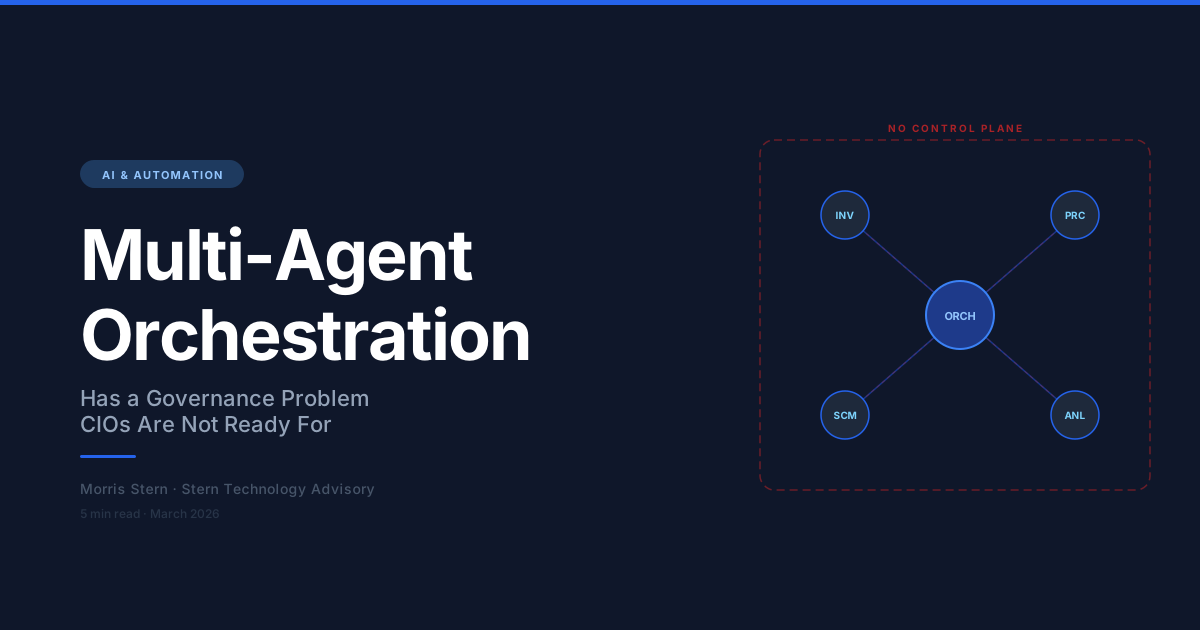
Enterprises are deploying AI agents at a pace that has outrun any meaningful governance structure. Gartner projects that 40% of enterprise applications will have task-specific AI agents by end of 2026 — up from less than 5% in 2025. Most organizations deploying those agents have no agent control plane, no agent identity framework, and no policy enforcement layer to speak of.
The pattern is recognizable. It is cloud shadow IT from 2012 through 2015, compressed and accelerated, with one critical difference: agents act. They don’t just store data outside the perimeter — they make decisions, trigger downstream processes, and communicate with other agents. When the governance conversation arrives after deployment, as it is arriving now, the operational surface at risk is far larger than a misconfigured S3 bucket.
What Most Leaders Are Missing
The dominant narrative positions this as a vendor-solvable problem. Microsoft, Salesforce, and ServiceNow are all competing to own the agent orchestration layer. Google’s Agent-to-Agent (A2A) protocol has attracted backing from more than 50 companies, including Microsoft and Salesforce — a clear signal that the industry has recognized the interoperability problem.
But interoperability is not the same as governance. What those vendors are building is a coordination surface. What enterprises actually need is a control plane — something that manages agent identity, enforces policy at runtime, audits agent decisions, and defines the boundaries within which any given agent can act.
The prerequisite for that control plane is clean, real-time, consistently structured data. The World Economic Forum found that fewer than 20% of organizations have achieved data readiness for AI. Without consistent metadata, reliable real-time pipelines, and federated identity for agents, governance frameworks are architectural fiction. Vendors are selling orchestration layers on top of foundations that do not yet exist for most of their customers.
Enterprise Implications
The architectural gap is specific. McKinsey has identified that AI agents require real-time, governed access to ERP data — and that most ERP environments were not architected for agent-scale API interactions. That is not a configuration problem. It is a structural one. ERPs built for human-paced transaction processing were not designed for hundreds of concurrent agent queries operating on live data.
The identity problem is equally concrete. In a multi-agent environment, each agent needs a verifiable identity, a defined permission scope, and an auditable action log. Most enterprises have mature identity and access management frameworks for human users. Almost none have extended those frameworks to non-human agents. The result is that agents are often running with inherited service account credentials, no individual identity, and no policy boundary beyond whatever the calling application enforces.
Salesforce’s 2026 Connectivity Report found that 50% of agents currently operate in isolated silos. A 67% surge in multi-agent adoption is projected by 2027. The window between now and that adoption curve is exactly where CIOs need to build their governance foundation — not respond to it.
The Retail Exposure Is Already Real
Retailers are among the earliest and most aggressive adopters of agent-based systems, particularly in supply chain, inventory rebalancing, dynamic pricing, and store operations. Those use cases are also where the coordination problem hits hardest.
A supply chain agent network requires communication across procurement, logistics, and merchandising systems — often operated by different teams with different data standards and different update frequencies. When a pricing agent and an inventory agent are operating on data that diverges by even a few hours, the decisions they make can conflict. An agent that reduces a replenishment order because pricing signals show softening demand, while a separate merchandising agent is preparing a promotional push, is not a theoretical risk. It is a governance failure with a direct operational cost.
Retailers who have moved fast on agent deployment have largely done so within single domains — pricing here, inventory there. The compounding value that Deloitte identifies as the primary benefit of agent orchestration only materializes when agents work across domains. That cross-domain communication is exactly where governance gaps become expensive.
What Leaders Should Do Next
The governance work that needs to happen before an orchestration layer is worth anything is not glamorous, but it is specific.
First, inventory what is already running. Most enterprises do not have a complete picture of what agents are deployed, what systems they touch, and what credentials they are using. That inventory is the starting point — not the architecture diagram, not the vendor roadmap.
Second, extend identity and access management to non-human agents. Every agent should have its own identity, its own permission scope tied to a defined function, and an audit trail. This is not a new concept — it is the same zero-trust principle applied to a new class of actor.
Third, do not accept a vendor’s orchestration layer as a governance solution. The orchestration layer manages coordination. Governance manages policy, compliance, and accountability. Those are not the same problem, and conflating them is how CIOs end up having inherited someone else’s framework when something fails.
Fourth, assess data infrastructure readiness before expanding agent deployment. If real-time pipelines are unreliable or metadata is inconsistent, multi-agent systems will amplify those problems — not paper over them.
The Bottom Line
CIOs who do not establish their own governance framework for agentic systems will not operate in a governance vacuum. They will operate inside whatever governance structure the platform vendor builds — optimized for the vendor’s ecosystem, not for enterprise accountability. The governance conversation is not coming. It is already overdue.