There is a version of the “fail fast” idea that consultants repeat in conference presentations and LinkedIn posts. It sounds clean. Move quickly. Learn from mistakes. Iterate toward success. The problem is that in retail, most technology pilots are not structured to produce learning. They are structured to produce approval.
That distinction is the difference between a pilot that builds a credible business case and one that generates a deck full of qualifications and a vendor relationship that has to be managed for the next three years.
What a retail technology pilot is actually trying to do
Before designing a pilot, you need to agree on what question you are trying to answer. This sounds obvious. It rarely happens.
The most common failure mode is a pilot designed to validate a decision that has already been made. The business case is written, the vendor is selected, and the pilot exists to give finance something to point to before approving the investment. In these pilots, success criteria are vague, measurement is inconsistent, and the learning that was supposed to happen gets compressed into a summary slide.
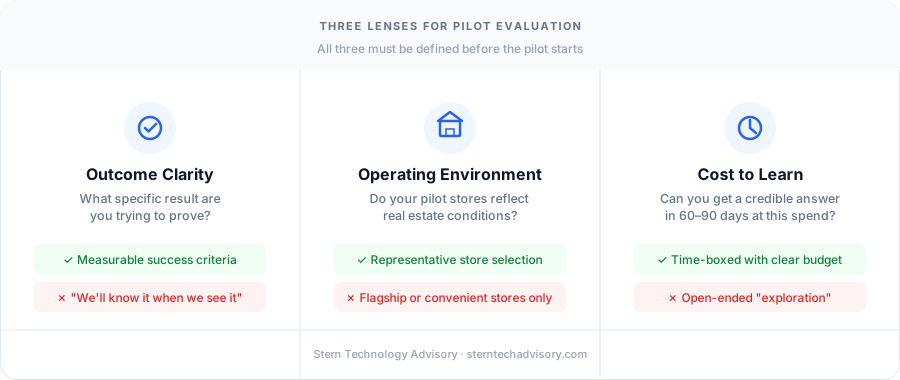
A pilot that produces real learning starts with a specific question: Does this technology deliver the outcome we need, in this operating environment, at this cost?
That framing has three parts. The outcome. The operating environment. The cost. All three need to be defined before the pilot starts.
The operating environment problem
Retail technology does not operate in a lab. It operates in a store with seasonal peaks, associate turnover, aging network infrastructure, and executives who want to see a demo during the busiest week of the year.
Pilots that succeed account for this. They choose stores that are genuinely representative of the estate — not the cleanest stores, not the stores with the most cooperative managers, not the stores nearest the head office. They design for the messy conditions that will exist at scale.
I have seen ESL deployments where the pilot was run in a flagship location with high-quality network infrastructure and a dedicated IT resource on-site. Chain-wide rollout hit integration failures in 40% of stores because the network profiles were completely different. The pilot produced the right answer for the wrong store.
Defining success before the pilot starts
One of the most useful things a technology leader can do before a pilot is write down, in one sentence, what a failed pilot looks like. Not just what success looks like — what failure looks like.
If you cannot articulate failure, you have not actually defined success. You have described a direction.
For a POS modernization pilot, failure might look like: associate training time exceeds 6 hours per employee, or average transaction time increases by more than 15 seconds, or system downtime during peak hours exceeds the threshold in the existing SLA. These are concrete. They are measurable. And they force a real conversation about what actually matters.
The “fix faster” part
The fail fast framing gets more credit than it deserves because people skip the harder half: fix faster.
In retail, the cost of a failed pilot is not just the cost of the pilot itself. It is the organizational credibility cost — the CFO who remembers the last three technology investments that did not deliver, the operations team that has built workarounds because the last system change broke their workflow, the vendor relationship that has to survive a failed deployment.
Fix faster means building your pilot governance so that problems get escalated and resolved quickly, not documented and deferred. It means having a clear decision framework before the pilot starts: what findings would cause us to stop, what would cause us to continue with modifications, and what would cause us to expand?
It means the people running the pilot have the authority to make those calls, or clear access to someone who does.
What good looks like
The best retail technology pilots I have been involved in had a few things in common.
They were run in stores chosen for their representativeness, not their convenience. They defined success criteria that were measurable before the pilot started. They had a governance cadence — a weekly check-in with real data, not just a status call. They built in a clear go/no-go moment, and everyone knew what evidence would drive which decision.
And they were not sold internally as an answer to a question that had already been answered. They were sold as the fastest way to get a credible answer — which is a different conversation, and a much more honest one.
The “fail fast” framing is useful when it means: design your pilots to surface the real constraints quickly, so you can fix them before they become chain-wide problems. It is not useful when it means: move quickly, learn nothing, and call the experience iterative.
In retail, the stakes of a chain-wide technology rollout are too high for that version of the idea.