
Most organizations don’t have an AI problem.
They have a cost visibility problem.
Over the past few months, I’ve seen a consistent shift in how enterprise leaders talk about AI. The conversation is no longer about capability. It’s about control. Specifically: “Do we actually understand what this workflow costs us to run?”
That question is going to define how successfully companies scale AI in 2026.
From Experimentation to Real Spend
Early GenAI felt cheap.
Small pilots, limited usage, innovation budgets absorbing the cost. It created the illusion that AI was just another tool you could layer into the business.
That breaks down fast once you move into real workflows.
Agentic use cases, document processing, customer interactions, internal copilots. These don’t scale linearly. They compound. And with that comes token consumption that most organizations aren’t instrumented to track properly.
At that point, AI stops being experimentation. It becomes operating expense.
Where This Starts to Break Inside the Enterprise
This is showing up in three places.
1. Spend That Doesn’t Behave Like Traditional IT. Token consumption is not predictable in the way infrastructure or licensing is. One workflow change can materially increase cost. Most organizations are not set up for that level of variability.
2. Ownership Becomes Blurry. AI initiatives are being driven by the business, not just IT. Now finance is involved earlier. Product teams are driving usage. Technology is still accountable for architecture. Without a clear model, this creates friction quickly.
3. Architecture Starts Driving Cost in Ways People Don’t Expect. This is the part that gets missed. Cost is not just about which model you choose. It’s about how your systems are structured. If your data is fragmented, if your workflows are inefficient, if your prompts are poorly designed, you are paying for it in tokens every time something runs. Most legacy environments were not built with this in mind.
What Most Teams Are Getting Wrong
A lot of the current conversation is about cost control. Limit usage. Set caps. Reduce token consumption.
That is the wrong framing.
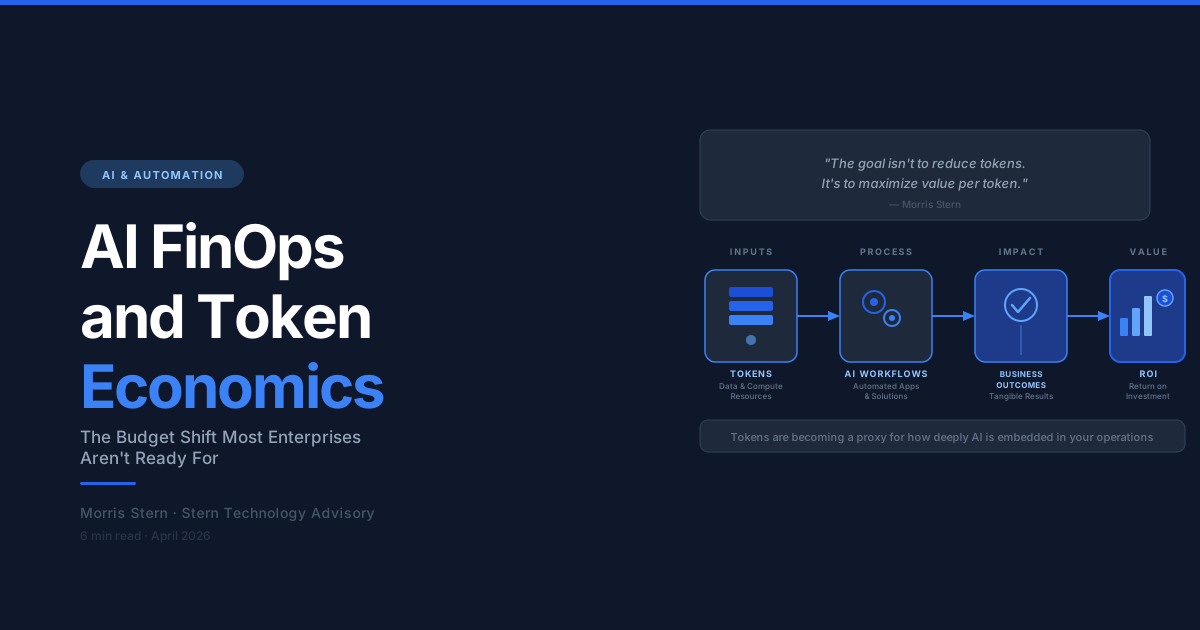
The goal is not to minimize tokens. It is to understand what you are getting from them.
I’ve seen environments where token usage is low, but so is impact. That is not efficiency. That is underutilization. On the other side, I’ve seen high usage tied directly to measurable outcomes — faster transactions, better conversion, reduced manual work. That is where this becomes interesting.
Tokens are not just a cost metric. They are becoming a proxy for how deeply AI is embedded into your operations.
Why This Matters More in High-Volume Environments
If you are operating in retail, supply chain, or any high-throughput environment, this gets amplified. Personalization, pricing, inventory decisions, customer service workflows — these are not low-frequency use cases. They run constantly. Small inefficiencies multiply quickly.
I’ve seen situations where architecture decisions that seemed minor created meaningful cost exposure at scale. Not because the technology was wrong, but because it wasn’t designed with usage economics in mind.
What Good Looks Like
The organizations getting ahead of this are doing a few things consistently.
They treat token usage as a first-class metric. Not a line item buried in a cloud bill — a tracked, reviewed operational number tied to specific workflows.
They tie consumption to specific business outcomes. Usage without a corresponding value measurement is noise. The question isn’t how many tokens ran last month — it’s what those tokens returned.
They introduce lightweight governance early, not after the fact. Guardrails set before workflows scale are cheap. Guardrails retrofitted after a cost surprise are not.
They design workflows with efficiency in mind from day one. Prompt design, data access patterns, model selection — these decisions compound. Getting them right early is far less expensive than optimizing later.
Most importantly, they connect this back to broader modernization efforts. You cannot solve token economics in isolation. It is tied to your data layer, your integration strategy, and how your systems interact.
Where to Start
If you are early in this, the focus should be straightforward.
Get visibility. Understand where tokens are being consumed and by which workflows. Without this, everything else is guesswork.
Map cost to value. Start connecting usage to outcomes. Even directional alignment is enough to begin. You don’t need a perfect attribution model to make better decisions.
Introduce guardrails, not restrictions. You want to guide usage, not shut it down. Budget thresholds, usage alerts, and workflow-level reporting are the tools — not hard caps that block productive work.
Look at your architecture honestly. This is where most of the inefficiency sits. Data access patterns, workflow design, and integration architecture all drive token consumption in ways that are not obvious until you instrument them.
The Real Shift
We are moving into a world where AI is not just a capability layer. It is an economic system inside the enterprise.
That requires a different level of discipline.
The organizations that figure this out will not necessarily be the ones spending the least. They will be the ones that can clearly articulate what they are getting in return.
And that is ultimately what will separate experimentation from real transformation.